SkilLab framework
4Q Selector: how to choose the right business simulation for the leadership objective
Strategic ↔ Operational × Individual ↔ Team
The 4Q Selector is a 2×2 matrix (Strategic ↔ Operational × Individual ↔ Team) that classifies business simulations by pedagogical focus. SkilLab uses it to pair the right simulator with the right program objective, avoiding the common mistake of buying a Markstrat for a demand Decision Base resolves in half the time.
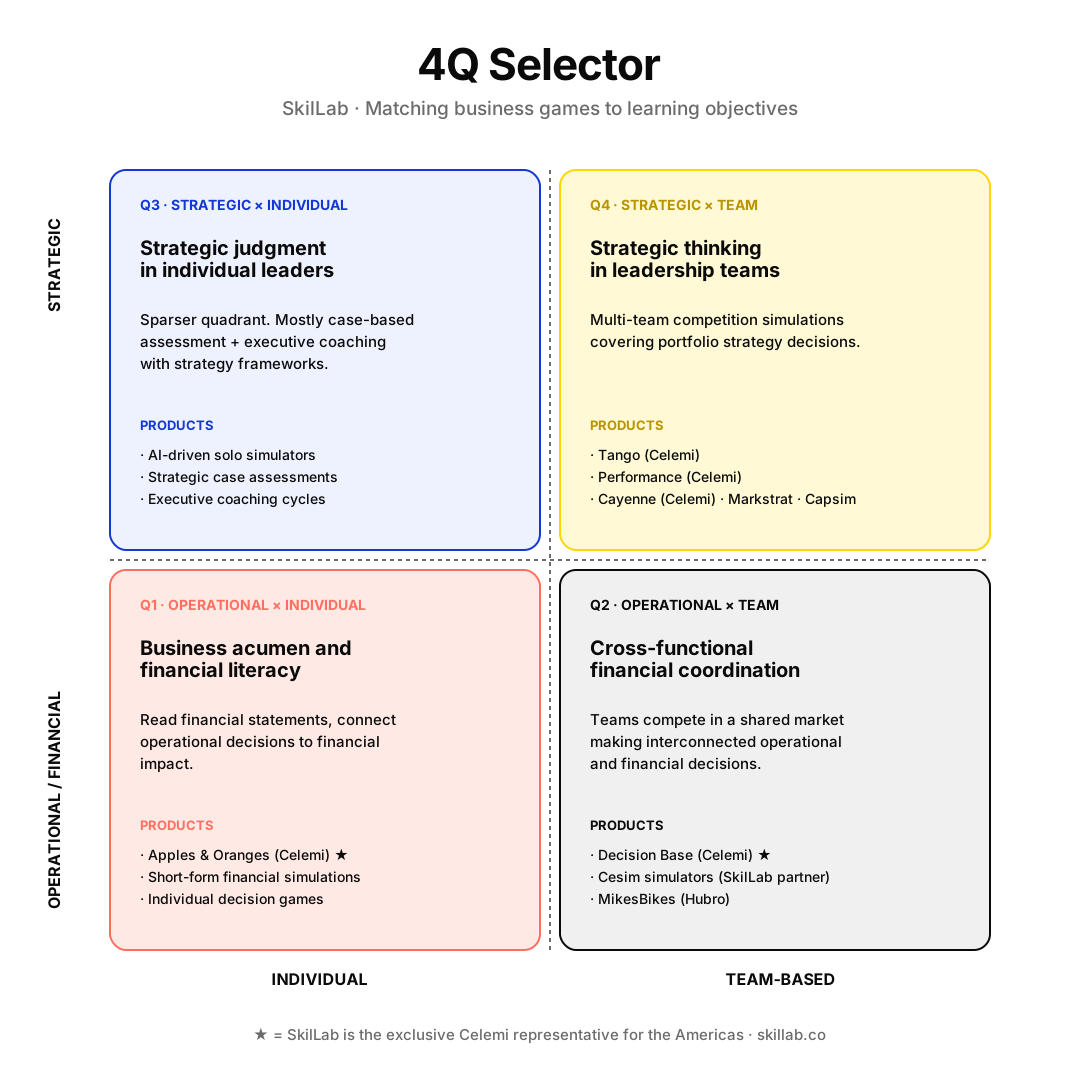
The four quadrants
Strategic × Team. Simulators where the team makes integrated executive decisions in a competitive market. Celemi Decision Base, Celemi Tango, Capsim CompXM. Focus: executive business acumen, integrated view, inter-team competition.
Strategic × Individual. Simulators focused on individual market strategy. Classic Markstrat. Focus: strategic marketing, competitive positioning, long decision cycles.
Operational × Team. Simulators of operational chains where the team manages production, quality, flow. Celemi Apples & Oranges (financial literacy anchored in operation), MIT Beer Game (supply chain). Focus: aligning operation with financial result.
Operational × Individual. Simulators of individual execution in operational or commercial context. MikesBikes Intro, Hubro Marketing, sales simulators. Focus: repeatable operational practice, fast decisions.
How to apply
Before buying any simulator, place the program objective in one of the four quadrants. If the objective is “high-potentials becoming CEOs”, you need Strategic × Team. If the objective is “new salespeople understanding margin trade-offs”, you need Operational × Individual. Buying a simulator from the wrong quadrant is the most common waste in Brazilian corporate HR.
We add a ★ marker to Celemi products in which SkilLab has Americas exclusivity (Decision Base, Apples & Oranges, Tango, Performance, Cayenne). It is not a technical classification — it is an operational note.
Related posts
- Business Games for Strategy and Leadership Training, the original post introducing the 4Q Selector.
- Decision Base (Celemi), the most-used product in the Strategic × Team quadrant.
- Apples & Oranges (Celemi), the most-used product in the Operational × Team quadrant.
When to use
- Decide which business simulation to buy for a leadership-pipeline or executive-MBA program.
- Defend to a sponsor the choice of simulator against well-known market alternatives.
- Reposition an underutilized simulator for a cohort where it actually fits.
When NOT to use
- Pure soft-skill training. Use FLEX or REAL.
- Technical learning of a specific tool. Simulators are too expensive for that.