SkilLab framework
FLEX: SkilLab's design cycle for corporate mind games that develop soft skills
Friction · Loop · Emotion · eXtraction
FLEX (Friction · Loop · Emotion · eXtraction) is a design cycle for corporate mind games developing soft skills, anchored in experiential learning (Kolb) and the psychology of emotional consolidation (LeDoux, McGaugh). All four elements must appear in the design for the game to produce behavior change rather than a fleeting insight.
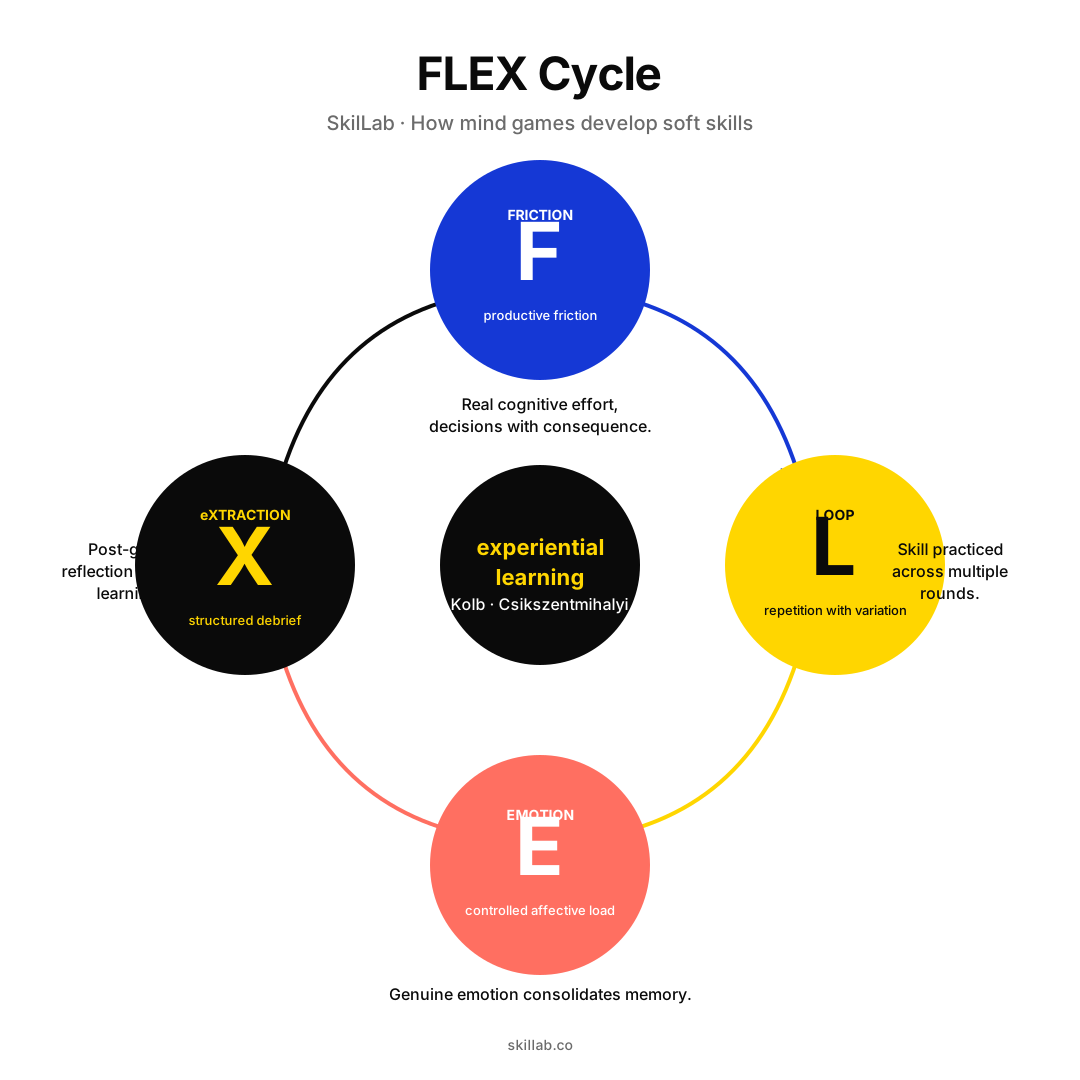
The four elements of the cycle
Friction. The game creates cognitive or emotional friction so the player must step out of autopilot. Without friction, the brain processes passively and consolidation does not occur. Diagnostic question: “does the player notice that they have to think differently to solve this?”.
Loop. The game offers short cycles of attempt, result, adjustment, new attempt. The loop is the unit of Kolb’s experiential learning. Diagnostic question: “does the player attempt the same situation at least three times, adjusting strategy between attempts?”.
Emotion. The game evokes a genuine emotion from the player, ideally surprise or mild discomfort. Emotional consolidation anchors long-term memory (LeDoux, McGaugh). Diagnostic question: “in the debrief, does the player report a specific sensation, not just an abstract takeaway?”.
eXtraction. The game ends with structured extraction that connects the experience to the player’s real-world context. Without extraction it remains episodic memory. Diagnostic question: “does the player articulate a real work situation where they would apply what they learned?”.
How to apply
Apply FLEX during design, not during facilitation. Each missing element becomes a retention hole. Use the cycle iteratively: draft, identify the weakest element, redo, pilot with 6 to 10 people, recalibrate.
FLEX is particularly sensitive to remote contexts. Emotion is harder to evoke over video than in person, and Friction must be made explicit so it is not missed. We compensate with mechanics that force visible decision-making on the shared screen.
Cases that apply FLEX
SPIC Exploding Feedback applies FLEX across five weeks of feedback culture: friction (cards of direct provocation), loop (weekly rounds), emotion (revealing the card author), extraction (public commitment registered at the end).
Related posts
- Mind games for soft-skills development, the original post that introduces FLEX.
- REAL Framework, complementary criterion for team-building that actually transfers.
When to use
- Design a new mind game for communication, feedback, leadership, or collaboration development.
- Audit an existing soft-skill activity that generates engagement but not transfer.
- Justify to leadership the structure of a soft-skill development program.
When NOT to use
- Tool-specific technical training. Soft skills require emotional friction; hard skills do not.
- Personality assessment. FLEX develops, it does not diagnose.